Operations Redesign | General Management
Your people didn’t choose theatre to spend their days pushing paper, scheduling Zooms, and chasing signatures. But too often, keeping things running takes everything they’ve got. There’s little time or energy left to imagine what comes next.
Substructure makes the work simpler. We bring deep theatre experience to designing, building, and maintaining the systems that connect your organization, so your people have room to do the work they came here for.
drew@substructure.co
We simplify the workflows your theatre runs on, with tools built around the way your staff already work. The data entry, the chasing, the double-checking, and the follow-up happen on their own. Your people keep the decisions, and we keep it all running as your theatre changes.
How it works ↓Contracts, negotiations, CBAs, budgets, and payroll, handled by people who have done the job at theatres like yours. For theatres that can’t hire that expertise, or have other roles to fill first.
How it works ↓Work with us on either one, or both.
Someone on your staff built it. It’s beautiful. It has tabs, color coding, and formulas nobody else fully understands. It holds the whole process together.
Then they leave.
The formulas break. The documentation, if there is any, describes a version from two years ago. The next person inherits the spreadsheet along with the job, and learns it the way everyone does: by breaking it.
Multiply that across every department, and this is where everyone’s time goes:
None of it is hard. None of it is anyone’s actual job. All of it adds up to somebody’s whole week.
When people hear what we do, they usually start picturing someone on staff who could take it on. The manager who’s good with spreadsheets. The IT contractor. Maybe a new hire.
None of them should have to.
Your staff are experts in their jobs. Their time belongs there.
Your IT keeps things running and fixes what breaks.
Substructure designs the systems that connect it all, and maintains them so they outlast any one person.
Every new tool comes with the same ask: change how you work to fit the software. Learn the new system. Sit through the training. Remember one more password.
That’s not what we do.
We start by sitting with the people who do the work and watching how it actually moves: the forms, the emails, the whiteboard on the wall, the three spreadsheets that track the same thing for three different reasons. Then we build around it. Information arrives in the format each department already uses. It lands in the tools people already rely on, like Tessitura, Outlook, and your finance system.
What disappears is the copying, the chasing, and the reconciling. What stays is the part that needs a person: the judgment calls and the conversations.
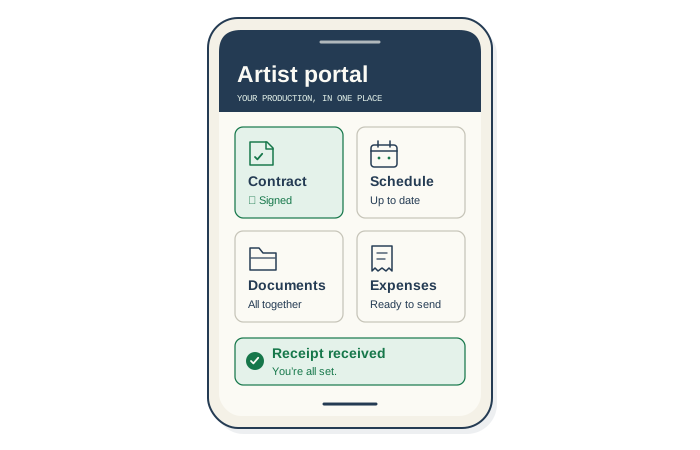
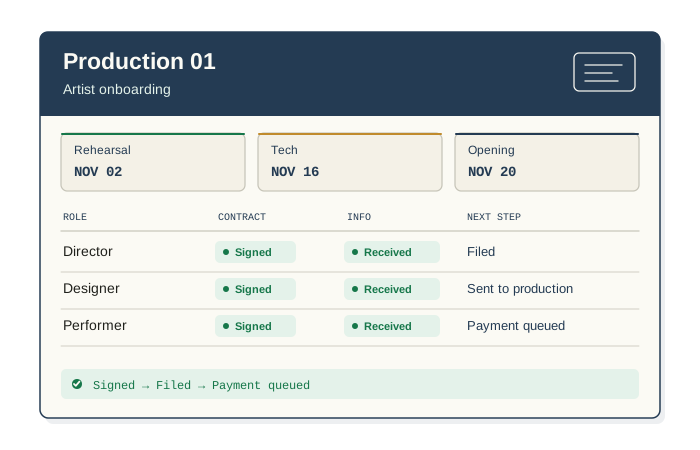
…your visiting artists had one app for everything. They submit the information every department needs, sign their contract, and always see the current version of their contract and calendar. On the way to the theatre, they snap a photo of a checked-bag receipt. The app creates a payment request with the right G/L coding, in the exact format your finance department wants, and the company manager gets a prompt to approve it. The budget updates on its own.
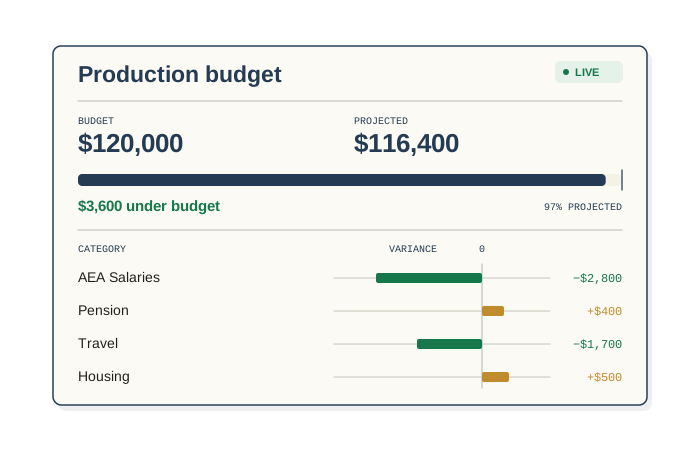
…your budget tracking was always current. It updates with every payment request and every credit card swipe, and your finance department doesn’t have to change how they work.
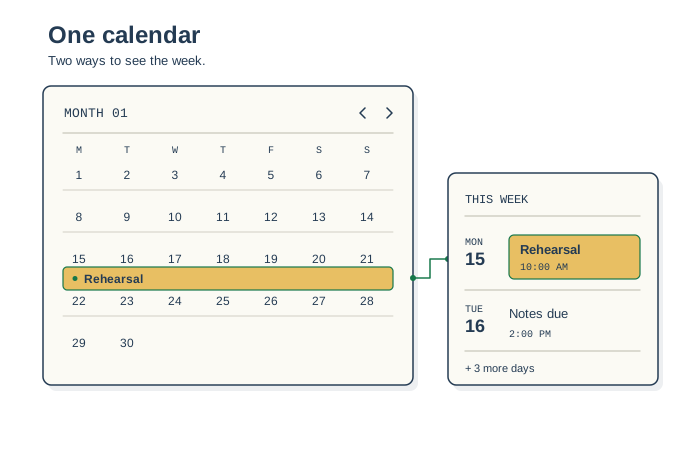
…your calendar had one source of truth. Every department, and every connected tool, sees it exactly the way that works for them.
…nobody had to follow up. Every step in a process hands off to the next one with everything it needs. Nobody has to nudge, ask, track, or send “just following up.”
Technology should adapt to people, not the other way around.
Some theatres have a great general manager. We love working alongside them, and our systems work makes their jobs easier.
Other theatres can’t find or afford someone with deep experience in contracts, negotiations, CBAs, budgets, and payroll. Or a longtime GM moves on, and the theatre has three other roles it needs to fill.
That’s where we come in. Our team takes on the general management work directly: negotiating, contracting, budgeting, and administering the agreements. We’re efficient because we work with the same kind of systems we build for everyone else. Your theatre gets the expertise, and your hiring can go to the roles you need most.
This is also where our two services meet. An artist contract touches the CBA, the budget, payroll, travel, housing, and production all at once. When the people negotiating the contract also built the system it runs through, nothing gets dropped between steps.
Technology is changing faster than any theatre can keep up with: new tools, new integrations, and now AI. Staff turnover means the person who understood last year’s setup is often gone. Every departure takes knowledge with it, and every new tool adds another seam.
Theatres are understaffed and costs keep rising, so nobody inside has time to keep it all straight.
We do.
We keep the systems current and documented as the tools and the people change, so your theatre doesn’t start over every time.
Substructure was founded by Drew Kowalkowski, who has spent nearly 20 years in almost every corner of a theatre: stage management and lighting design, producing, production, marketing, fundraising, finance, and general management. He has built new organizations from the ground up and worked inside storied institutions.
He was COO of Thompson Turner Productions, the general management office behind The Book of Mormon, Company, and Mean Girls on Broadway, and operations manager of the Westside Theatre. In nonprofit theatre, he has held leadership roles at Central Square Theater and Indiana Repertory Theatre, and today serves as general manager of IRT and Geva Theatre through Substructure. He holds an MFA in Theatre Management and Producing from Columbia.
His proudest work is Wheatland Theatre Company, which he founded in a rural county of about 10,000 people. It became the county’s only nonprofit arts organization and the only theatre in its congressional district to receive NEA funding. Professional artists from across the country made theatre alongside local volunteers, many onstage for the first time.
Across all of it, Drew’s expertise has been less about any one department than about how the departments fit together. And at every stop, he’s been the one figuring out how to make the technology work for everyone else.
Connect on LinkedIn ↗We’re growing. The people joining us care deeply about this field, are invested in its future, and want to change the way things are done.
See open roles →The American resident theatre was built by people who were practical about their idealism.
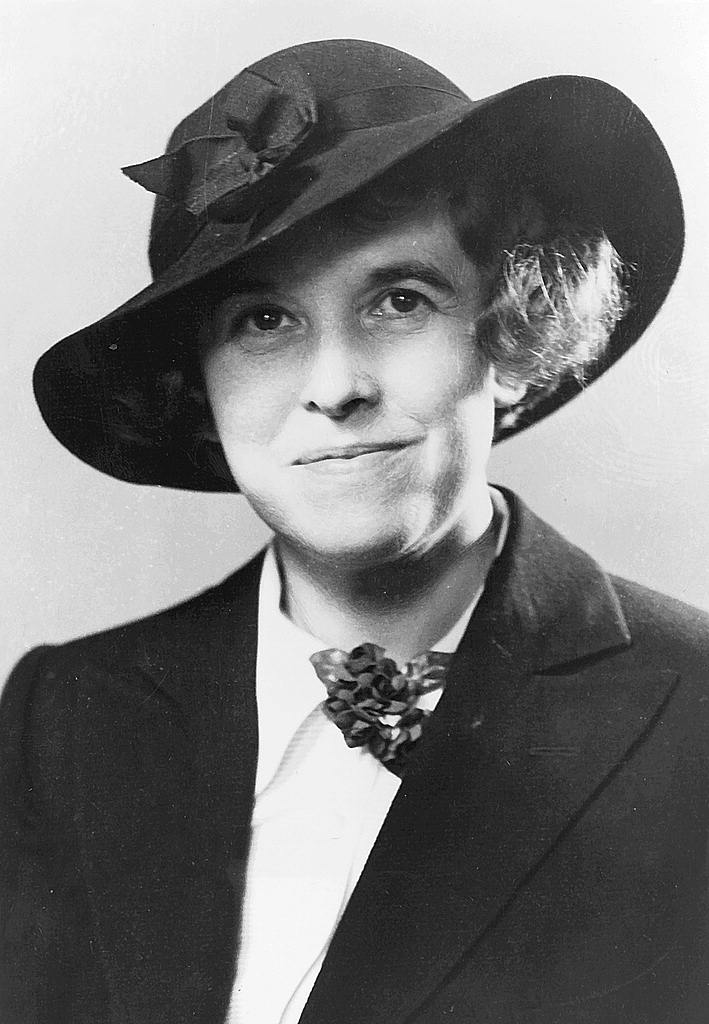
In 1935, in the middle of the Depression, Hallie Flanagan stood in front of the first regional directors of the Federal Theatre Project and asked them to build something that didn’t exist yet:
Our whole emphasis in the theatre enterprises which we are about to undertake should be on re-thinking rather than on remembering.
Hallie Flanagan, 1935
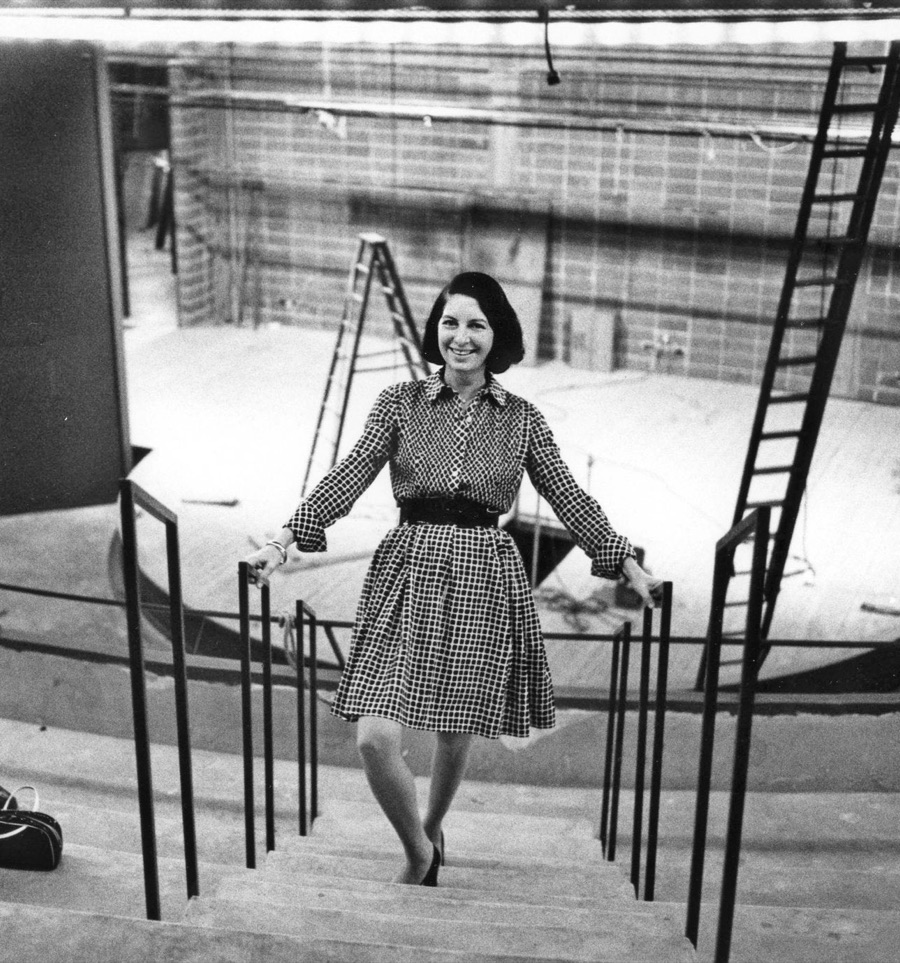
A decade later, Margo Jones imagined forty professional resident companies across America. Zelda Fichandler read that vision and saw a movement. At Arena Stage, building it meant turning an old movie house into a theatre and scraping the gum off the seats. Big ideas and practical work belonged together.
They built institutions to protect the art. By 1986, Fichandler could see those institutions starting to take more than they gave:
Unless we get it right, this “institution business” is going to kill us.
Zelda Fichandler, 1986
She wasn’t arguing against management. She was arguing for structures that serve the work they were built for.
That’s still the job. The challenges are different now: thinner staffs, faster technology, constant turnover, rising costs. The answer isn’t another layer of tools and processes stacked on the old ones. It’s getting back to basics: asking what the work actually needs, and building only that.
We’re charting a new course for how theatres run, rooted in a deep understanding of the people who built them and why. The people running theatres today have ambitions every bit as large as the founders’ did. We want more of their attention going to the work, and to the American theatre we’re all still building.
Tell us about it.
Let’s talk drew@substructure.co